How to get PubConsent with Google Consent Mode
This guide will accompany you step by step in the configuration and integration of PubConsent, ensure compliance with the latest version of Google consent mode as well.
1. Account Creation
To start using PubConsent, you need to create an account. If you already have an account, you can skip to the next step.
Follow these simple steps:
- Create your account here: https://os.pubtech.ai/subscribe
- Verify your email address by following the instructions sent to your inbox.
Once registration is complete, you can access your account.
Link to access your account: https://os.pubtech.ai/login
2. Configuration
Configuration of PubConsent is simple and intuitive: PubConsent Configuration Just a few steps to customize the settings: 1. Navigate to the "Configure PubConsent" section. 2. Click on the edit button for the website in configuration. 3. Save the changes. Be sure to explore all available options to adapt PubConsent to your specific needs. For advanced configuration uses, you can consult the In-depth Guides section.
Currently you can choose between two types of CMP, one based on TCF and one based exclusively on Google Consent Mode.
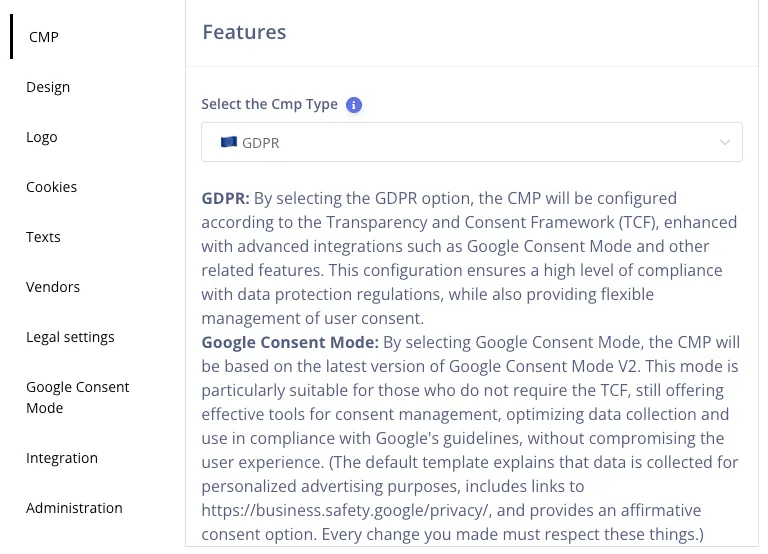
3. Integrate PubConsent
To integrate PubConsent into your website or app, follow the specific instructions for the platform you are using.
- Web: Follow the guide for integrating PubConsent into the HTML code of your website. -> Standard Integration
- AMP: Use the AMP components provided by PubConsent to integrate tracking into your Accelerated Mobile Pages (AMP) content. -> AMP Integration
- Android: Follow the guide -> Android Integration.
- iOS: Follow the guide -> iOS Integration
4. How to implement Google Consent Mode
To implement the Google Consent Mode we have specifically created two guides:
- GTM Integration (Consent Mode) - No Code
Or, if you are using the version of the CMP with TCF, you can enable Google Consent Mode through the TCF flag (enableAdvertiserConsentMode) available in the Google Consent Mode section of our configurator.
When using TCF flags, the CMP script must load first, prior to any Google tags. Do not use async, defer, or type="module" attributes for this integration.
Debug
Use the PubConsent GCM Debug System to analyze the integration:
- Console Logs: Enable "Debug" in the configurator to view detailed logs in the DevTools Console tab.
- Debug UI: Append ?pubtechGoogleTagsDebug=true to your URL or execute window.__pubtech_google_tags_debug() in the console.
- Note: Ensure you have interacted with the CMP UI (Accept/Reject) before triggering the debug window.
Google Consent Mode in Apps
To integrate the GCM also in your apps please follow the related documentation where is available the code snippet that make this possible:
- Android Integration (Google Consent Mode V2 Section)
- iOS Integration (Google Consent Mode V2 Section)
If you need more information about troubleshooting the Google Consent Mode see the official documentation here: https://developers.google.com/tag-platform/security/guides/consent-debugging
5. Google Tag Gateway (Recommended)
Unlock better performance and streamlined data management by integrating Google Tag Gateway (GTG). This feature is designed to give publishers more control over their tagging infrastructure while staying ahead of evolving privacy standards.
Why Switch to Google Tag Gateway?
Benefit | Impact |
|---|---|
Drive Conversion Uplift | Improve data accuracy and signal quality, leading to better optimization and higher ROI. |
Minimize 3rd-Party Interactions | Reduce reliance on external scripts, improving site performance and security. |
Privacy by Default | Built with a privacy-first architecture to help you navigate a cookieless future. |
Simplified Implementation | Enjoy a frictionless experience with automatic setup via CDN and intuitive UI configurations. |
Get Started: Implementation & Verification
Ready to optimize your setup? Follow our comprehensive guides to ensure a seamless integration of Google Tag Gateway and Google Consent Mode (GCM).
Proper integration of Consent Mode is essential for modeling lost conversions. Don't skip the verification step after GTG integration!
Insights
In addition to the information you find in this guide, you can visit the complete documentation and our in-depth guides:
- Guides